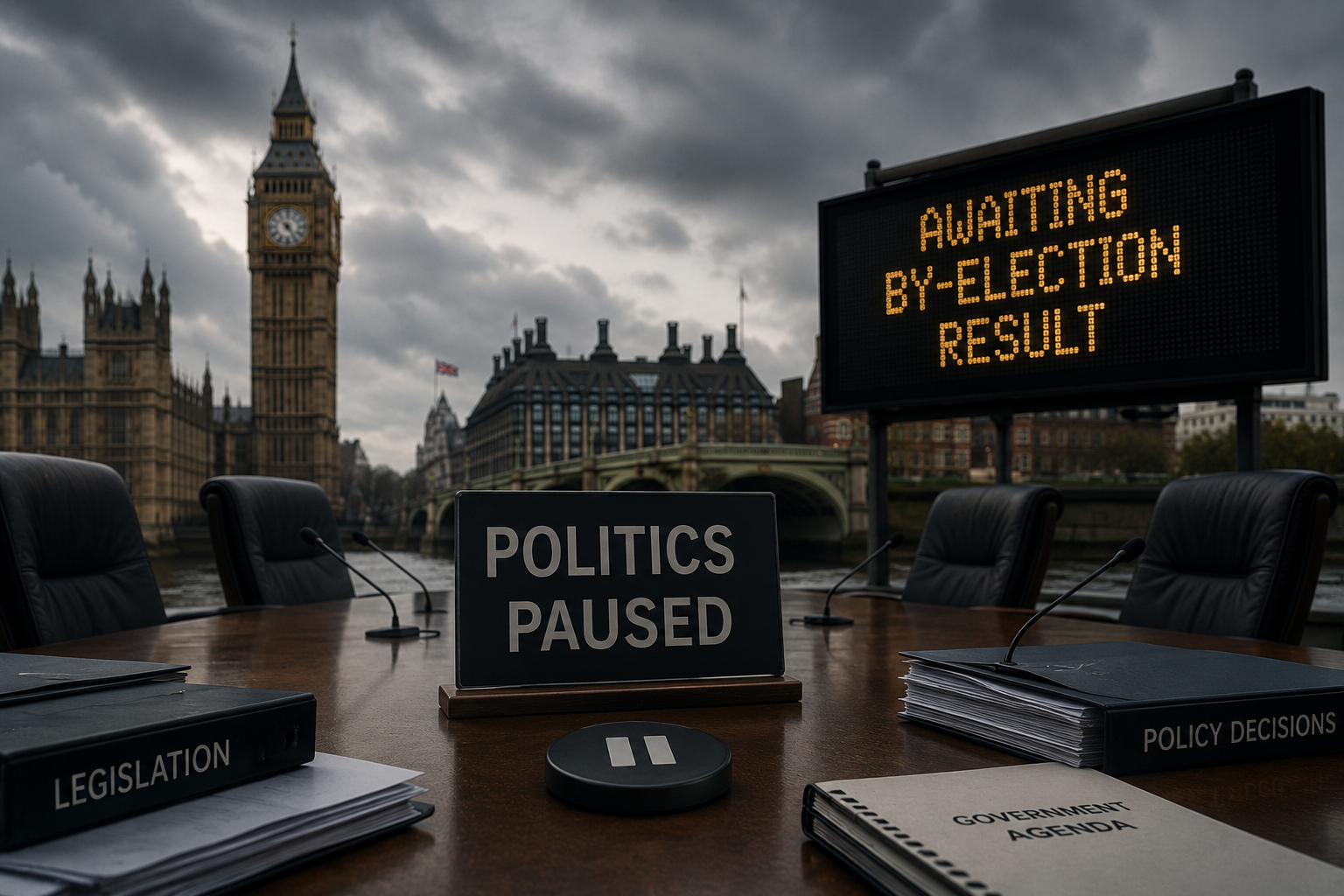
As Westminster waits for the outcome of the Makerfield by-election, British politics has entered another familiar holding pattern.
Government slows to a crawl. Ministers become cautious. Political parties retreat into internal calculations, polling analysis, and message testing. Every conversation becomes about what one by-election means for the next election, rather than what the country urgently needs now.
But while Westminster pauses, the crisis in British democracy does not.
The structural problems driving distrust, disillusionment, and political alienation continue to deepen in plain sight. Public faith in politics remains dangerously low after years of scandal, instability, and a growing sense that political power is increasingly concentrated in the hands of a wealthy and connected few.
And yet the reforms capable of rebuilding trust continue to be treated as optional.
Dark money still moves through British politics with far too little transparency. Large donations continue to buy access, influence, and political proximity in a system where ordinary voters often feel unheard. Wealthy individuals and organisations are able to exert disproportionate influence over public life while safeguards remain weak and enforcement mechanisms lack teeth.
At the same time, meaningful proposals to clean up politics are repeatedly delayed, watered down, or ignored altogether.
Among the clearest examples is the continued failure to seriously pursue donation caps.
A cap on political donations would be a straightforward democratic safeguard. It would help limit the concentration of political influence among a tiny number of wealthy donors and encourage parties to build broader public support instead of relying on a handful of major funders. It would send a powerful signal that democracy should belong equally to every citizen, not simply those with the deepest pockets.
Polling consistently shows that the public understands this instinctively. People know that when money dominates politics, trust collapses. They know that a political system dependent on large private donations creates the perception — and often the reality — that influence can be bought.
Yet despite years of concern about lobbying, political finance, and declining trust, Westminster still refuses to act with urgency.
Democratic reform cannot remain an afterthought. It must become central to political renewal.
The Representation of the People Bill offers an opportunity to begin that renewal.
At its core, the Bill recognises a simple democratic principle: political power should be accountable to the public, transparent in its operation, and resistant to the distorting influence of concentrated wealth. It offers a pathway toward rebuilding trust at a moment when trust is urgently needed.
Measures such as stronger transparency requirements, tougher safeguards around political finance, and meaningful donation caps are not abstract constitutional debates. They are practical reforms designed to restore integrity to public life and reconnect people with democracy itself.
The Bill also reflects a broader truth too often ignored in Westminster: democratic systems require maintenance. Trust does not survive indefinitely on tradition alone. Institutions cannot remain healthy while public confidence erodes year after year.
Without trust, everything becomes harder.
The Makerfield by-election will eventually produce a winner. Parties will analyse the result, publish their spin, and move onto the next political contest. Westminster will resume its rhythm.
But unless Britain confronts the deeper democratic failures beneath the surface — the influence of dark money, the absence of meaningful political finance reform, and the growing disconnect between politics and the public — the instability and distrust consuming public life will continue to grow.
The country does not need another period of political waiting.
It needs democratic renewal.


